

Why Am I So Itchy At Night?
Applying science to the perimenopause crowd

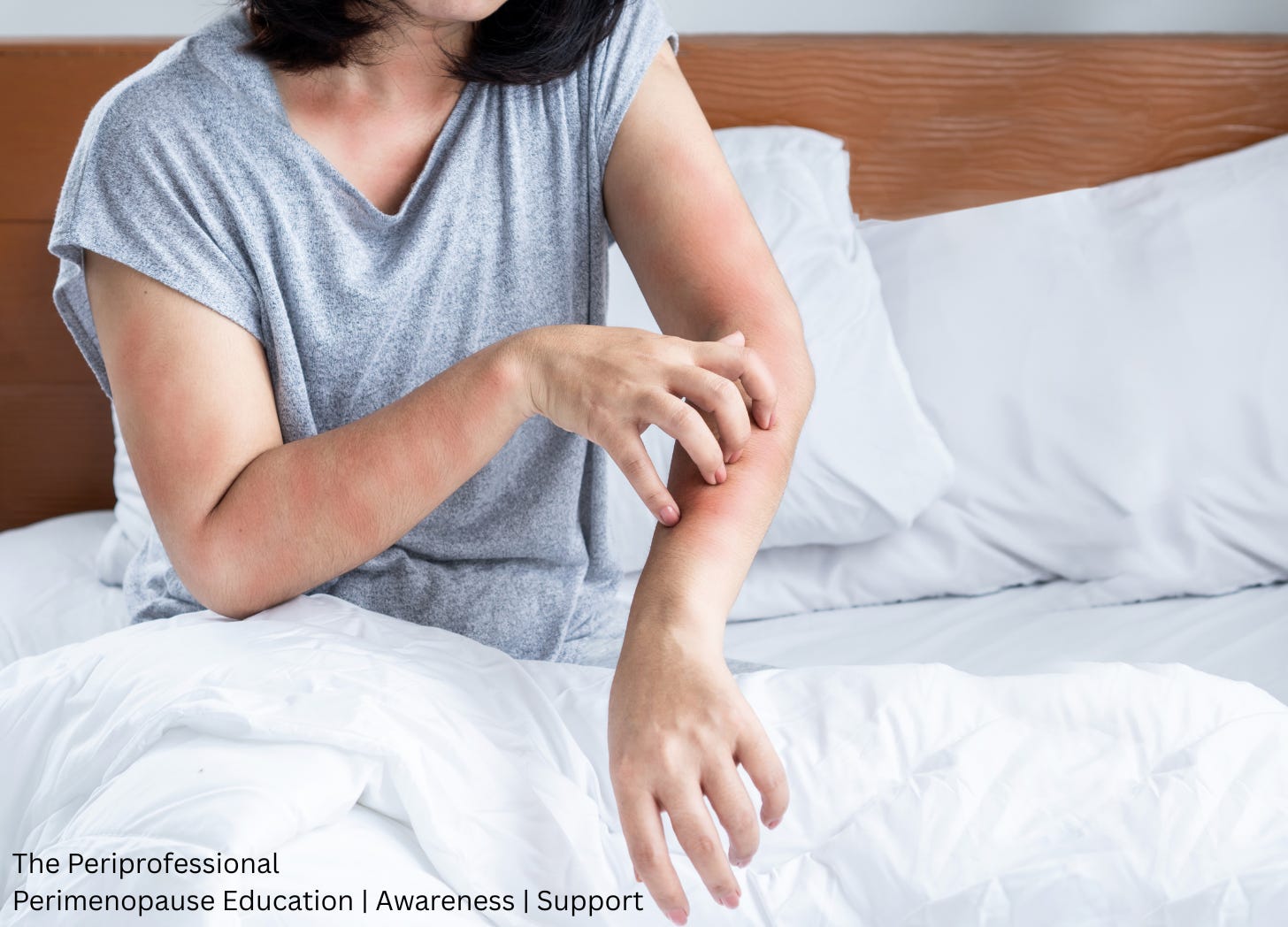
Are you itching something, or are you scratching it? This one always trips me up.
Since starting perimenopause, have you become a member of the Anti-Itch Club? You probably never gave itching much thought before, but maybe now you’ve found it consumes your thoughts all day.
In perimenopause, we have plenty to be itchy about:
✅ Anal Itching

✅ Itchy Ears

✅ Vaginal Itching

✅ Itchy Feet

Itchy eyes, itchy scalp, itchy elbows, hives, unexplained rashes, and, of course, general body itching. It could drive a woman crazy! Day and night! And it does!
Why Is Nighttime Itching Driving Me CraZy?
A recent study in the Journal of the American Medical Association (JAMA) Dermatology1 reveals why itching at night seems to be worse, so let’s take a look at what the researchers at the Miami Itch Clinic discovered and how I believe this information applies to perimenopause.
Isn’t that a great name? The Miami Itch Clinic.
The medical term for itching is pruritus. When it becomes a chronic issue, it’s called chronic pruritus.
Nighttime itching is more complex than claiming that because we’re busy in the day, we don’t notice it as much. It’s believed that several physical factors actually cause more itchy sensations during the evening and overnight.
Histamine
You’re probably familiar with “antihistamines,” which are medications, both over the counter and prescription, that block the effects of histamine, which is an immune system chemical that is released by mast cells in response to an allergen or irritant.
Histamine release can cause itchiness.
Histamine levels generally follow their own rise-and-fall patterns throughout the day and evening, however there is a significant surge of histamine around 10 pm and later. Many perimenopausal women say that they can fall asleep easily, but then wake up with a jolt in the early hours (if you’ve fallen asleep before 10pm, you may wake up with a jolt around this time). This may be due to a histamine surge.
When you wake up, you may realize how itchy you are.
For us in perimenopause, we can become histamine intolerant as histamine and estrogen are linked. If fluctuating estrogen levels are affecting your body’s ability to clear released histamine, you end up with an overload of histamine, causing symptoms such as itchiness.
I like to think of the bucket theory when it comes to histamine. Your body does its best job of clearing histamine when the histamine bucket isn’t full, but once the bucket gets full, depending on what you’ve done that day to expose yourself to allergens, your body can’t do its best work.
There’s also histamine in foods like grapes, strawberries, alcohol, caffeine, and cheese. You may find yourself suddenly itchy after consuming these foods, even if you’ve never had an issue prior to perimenopause.
Being on hormone therapy may also trigger histamine intolerance.2
I’ll caution you that if you don’t already take antihistamines, like for environmental allergies, I wouldn’t try experimenting with them once you enter perimenopause. If it turns out your problem isn’t histamine-related, and you take antihistamines anyway, there can be consequences for our sensitive bodies, such as increased anxiety and brain fog. Well, at least now you know.
Circadian Rhythm
Our circadian rhythm controls so many chemical releases throughout the day and evening, not just cortisol or melatonin, which are two common chemicals mentioned frequently.
Neuropeptides and cytokines (the ones we’ve heard about during COVID as it relates to “cytokine storms” that can be deadly) also increase itching sensations and rise during the evening hours.
Skin Temperature
In the general population, skin temperature rises overnight by one degree Celsius, but for perimenopause women having a hot flash/night sweat our skin temperature rises on average 2.7 degrees Celsius. Anyone with an Oura Ring can confirm this.
A hotter skin temperature will activate nerve endings, making skin more itchy.
Skin Permeability
The skin barrier becomes more permeable overnight, so whatever chemicals are involved in this process may be causing inflammation, or the very act of having more permeable skin may be making us more itchy. This may be why skin care companies make specific nighttime creams to take advantage of being able to absorb more of the ingredients.
Skin Dryness (specific to perimenopause, not included in the study)
Skin can become drier at night, leading to itching due to dehydration, evening alcohol consumption, and the above skin permeability issue, which increases dermal water loss. In addition, our natural oils are at their lowest levels in the evening. These oils are important for keeping the skin moisturized.
As these factors play a role in the general population, I believe they play a heightened role in perimenopause as our nervous systems go haywire trying to best adapt to the hormonal changes through the transition. Things become amplified to a noticeable level that are going to make the above issues more pronounced.
The 4 Itch Subtypes
Several things can cause the itch and are typically grouped into 4 subtypes, which can overlap and present together (Ug! As if having one type of itch isn’t bad enough).
⚠️ I’ll stress here that if you have itchiness and can’t determine the cause on your own, please see a health care provider. Although going to the doctor for itchiness may seem silly, it’s necessary to determine the cause or, at the very least, rule out causes.
Inflammatory - caused by skin conditions such as eczema or psoriasis
Nerve-related - no visible rash, but nerves are transmitting signals of itchiness that can be due to nerve damage
Systemic itch - this one is serious and is caused by a systemic disease often not yet diagnosed, such as liver disease, cancer, or multiple sclerosis.3
CPU - chronic pruritus of undetermined origin. The cause is unknown
Not Just A Silly Itch
Nighttime itching and sleep quality are definitely linked together, unfortunately, just like chronic pain and sleep quality. As simple as it seems, being itchy can wreak havoc on our quality of life. Don’t believe me? Just ask someone who’s dealt with chronic hives or unmanaged itching.
If itching is affecting your sleep or bringing you down otherwise, it’s time to see your general health care provider, allergy specialist, or dermatologist.
This Week on The Period Break
The Period Break is my Monday source of supercharged women’s health information for peri-pausies who want to uplevel their perimenopause experience with my best advice.
The Things That Ramp Me Up in Perimenopause

I’ve spent a lot of time in recent years learning about how our nervous system works and why it gets superactivated in perimenopause. And, it’s usually in a way that we’re not used to.
🦫 The groundhog says, “6 more weeks of perimenopause symptoms!”
Want to put your perimenopause symptoms into hibernation? Meet with me!

I can help you feel better in 45 minutes by sharing everything you need to know about your unique perimenopause worries and concerns, offering tips to help manage your symptoms through lifestyle suggestions, and answering your questions.
👉 Virtual, Email, Audio, and Text Appointments available! Booking February and early March appointments!
Learn more and book online using my HIPAA-compliant client portal.
Want to learn more on your own? Paid subscriptions to The Periprofessional will lead you on a path of perimenopause self-help where you’ll receive bonus advice and special support 💖 reserved for my consulting clients, plus direct access to me. Monthly and annual options available.
Be well, stay cool…

Shelby Tutty, MHA
Certified Perimenopause Educator
Founder of The Periprofessional, LLC

Disclaimer, Content Use Policy, Privacy Policy
Edwards E, Jackson-Cowan L, Khalil N, Yap QV, Yosipovitch G. Sleep Disturbance as a Mediator Between Itch and Quality of Life. JAMA Dermatol. Published online January 28, 2026. doi:10.1001/jamadermatol.2025.5449
Kaye, Philippa. The Science of Menopause. Penguin, 15 Oct. 2024.
Garibyan L, Rheingold CG, Lerner EA. Understanding the pathophysiology of itch. Dermatol Ther. 2013 Mar-Apr;26(2):84-91. doi: 10.1111/dth.12025. PMID: 23551365; PMCID: PMC3696473.
Thank you for this informative post. Had no idea nighttime itching was this common for women going through perimenopause.
I feel the itch in my lower (restless) legs at night!